
Last week, in Part 1, we explained why building a reliable document-processing agent is a science problem, and how synthetic environments and harness optimization prepare the agent for each customer. This part covers what happens once the agent is live. It shows how the agent checks its own work, why those checks stay strict, and how it performed in a production pilot.
Why the agent must pass a business check
Consider insurance servicing. A hand-filled form carries a few identity anchors, such as policy number, Social Security number, owner name, and date of birth. If they match the carrier’s system of record, the transaction advances automatically. If not, a person checks whether the form was simply misread.
That’s the insight behind our approach. Reading accurately isn’t enough. Critical fields must pass a business check, such as a record lookup, registry, checksum, or business rule, before the document can proceed. We call this extraction under a processability constraint.
Why the agent needs an outside check
Asking a language model to critique itself doesn’t reliably improve accuracy without an independent signal. And many checkers used with AI models are learned and approximate. If they reveal the target answer, the model can simply game them.
Our verifier is different. It’s exact and binary, answering only “match” or “no match” without revealing the stored value. The model can’t copy an answer it never sees, so every correction has to come from looking at the page again.
How the agent turns a failed check into a second look
In most pipelines, a failed check simply routes a document to manual review. Our agent treats it as feedback instead. Take a handwritten contract number, SS-5849201 (all values here are synthetic). A single-pass reader sees 55-5849201, and the lookup fails. Our agent proposes alternatives and tests them against the same lookup until SS-5849201 comes back found.
Here’s how the loop works.
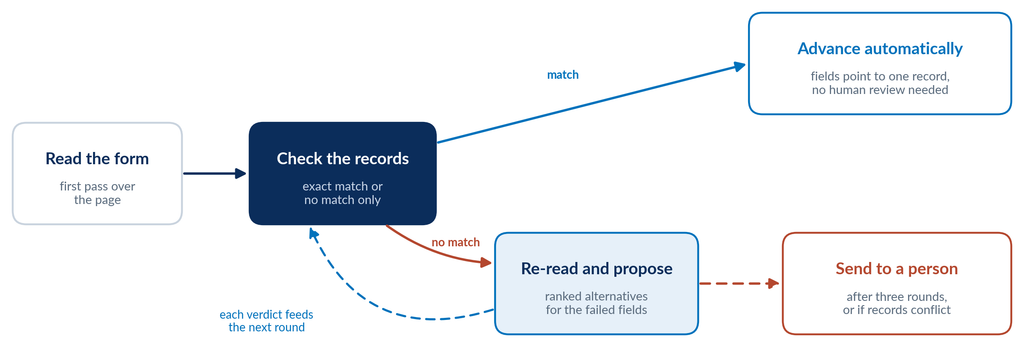
- After a single-pass read, only the fields that fail verification are revisited.
- The model looks at the page again and proposes a short, ranked list of alternate readings, using commonly confused characters such as S/5, B/8, O/0, and Z/2 as hints, not fixed rules.
- Simple format checks reject malformed candidates, and the rest go to the verifier.
- The verifier returns only a typed verdict, such as found, not found, or exists in a different record. It never reveals the stored value.
- Verdicts feed the next attempt, up to three correction rounds. A document advances automatically only when the confirmed fields point to a single record, either policy number and SSN or any three present fields.
These typed verdicts guide the model without exposing data. In one illustrative run, a date of birth read as 13/40/1956 is rejected on format, 01/03/1956 comes back as exists in a different record, and 01/08/1956 is confirmed. Each verdict tells the model where to look again, never what the answer is.
A few details make the loop work. Each round, the model sees the page image, the OCR text, the fields still unresolved, and a history of every candidate it has tried with its verdict, so it never repeats a failed guess. Confirmed fields stay locked. Acceptance is strict. The confirmed fields must point to exactly one record, and if candidates point to different records, the agent abstains rather than guessing. The loop stops as soon as the business rules are satisfied, or after three rounds, when the form goes to a person.
The agent’s design matters more than the model
Our strongest result comes from an offline benchmark designed to separate the method from the model. We ran 204 hand-filled forms through five GPT and Claude models, each in four extraction setups. Self-correction lifted every model to 93.2–97.6% field exact match, while no single-pass setup exceeded 76.2%.
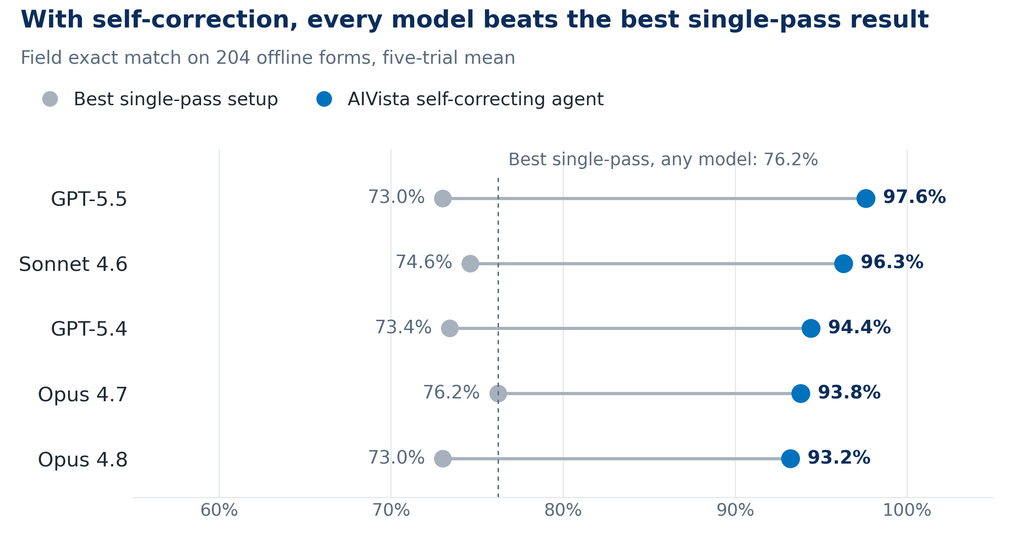
The weakest model with self-correction beat the strongest model without it. How the system is built mattered more than which model it uses.
How the agent performed in production
We tested the agent in a controlled production pilot from June 30 to July 20, 2026, live inside a US insurance servicing customer’s environment, across three carriers and a system of record with more than 2 million records. The production agent runs on GPT-5.5. The pilot focused on the hardest cases, 172 handwritten forms below the customer’s OCR confidence threshold that were headed for manual review. Each form carries four identity fields that must match the carrier’s records before it can move forward, the policy number, Social Security number, owner name, and date of birth. Human auditors provided reference values for every form, and we compared the same reader with and without self-correction, under the same business rules.
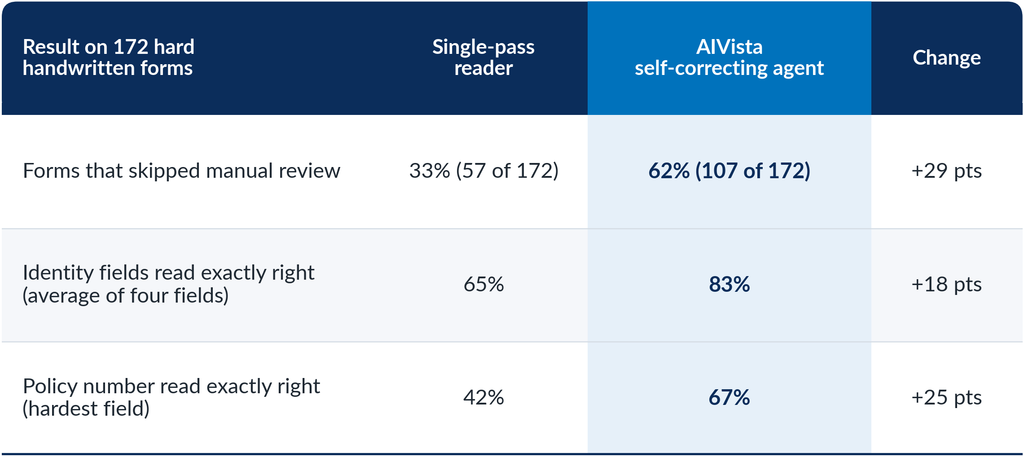
The agent recovered 50 of the 115 forms (43%) that the single-pass reader had sent to review, though 65 still needed a person. The biggest gains came on the hardest field to read, the policy number, which mixes letters and digits. Because the agent runs asynchronously between queues (median latency 198 seconds, 90th percentile 397 seconds), it’s built for throughput, not real-time response.
Estimated impact. The pilot targeted the hardest forms. The carrier estimates that about 20% of handwritten production forms are low-confidence, and that on the other 80%, self-correction lifts auto-advance from about 84% to about 96%. Weighted together, that’s roughly 15 more auto-advanced forms per 100 handwritten forms, meaning fewer manual reviews for the operations team. The review labor saved outweighs the added cost of running self-correction.
The misreads the agent catches
Each row below is one field from a hand-filled form. The first read shows what a single-pass reader saw, and the corrected read shows what the agent confirmed against the records. Most are classic handwriting confusions.
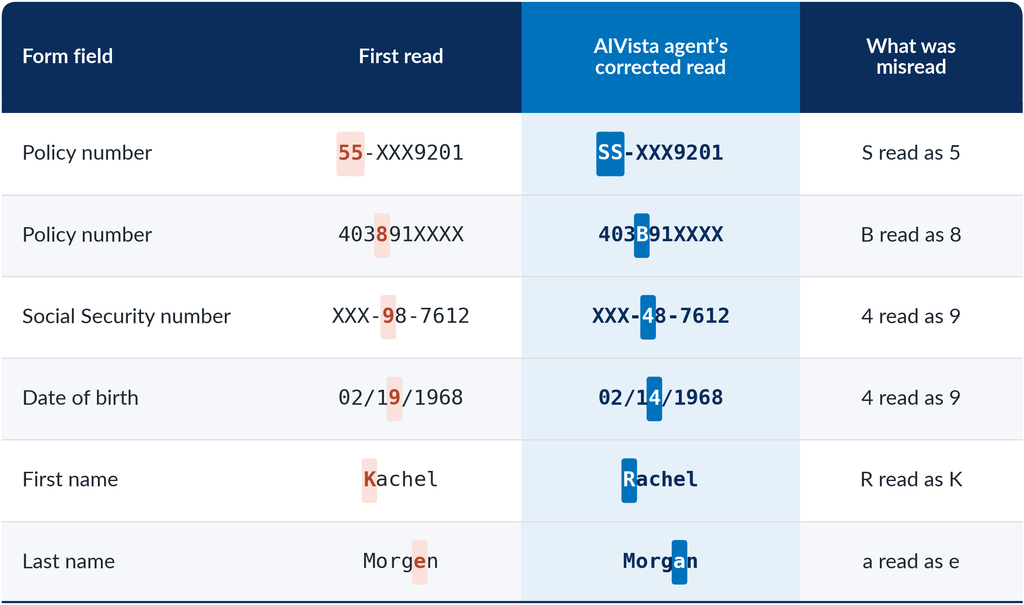
Fabricated values from the human-filled vendor forms; some digits masked.
The same kinds of confusions recur across field types, which is why one short list of look-alike hints works for IDs, digits, dates, and names alike. Policy numbers, with their mix of letters and digits, remain the hardest field.
Fewer record checks, same or better accuracy
A common alternative is to try every look-alike variation of a reading, swapping S for 5 or B for 8, and check each one against the records. We compared that approach with self-correction on policy-number and Social Security number fields, giving both the same limit on record checks. With up to 10 checks per field, the agent was 7.3 points more accurate (82.6% versus 75.3%) while using slightly fewer checks. With up to 100 checks, it was still 2.0 points more accurate and used about 70% fewer checks. In short, the agent makes fewer calls to the system of record while matching or beating the alternatives. Fewer checks also mean fewer chances to match the wrong person. A loose check on 55-5849201 could have matched a different customer’s 55-5848201.
Simple yes-or-no feedback is enough to get this efficiency. Under the same three-attempt limit, letting the agent learn from each verdict roughly halved the number of record checks compared with checking three guesses at once, at similar accuracy. Telling the model exactly which characters were wrong would improve accuracy further, but the production check deliberately doesn’t reveal that.
Keeping the agent safe, private, and affordable
- Safety. In a simulation against 100 synthetic databases of 2 million records each, self-correction raised correct-record acceptance from about 69% to 95%, while wrong-record acceptance stayed below 1%. In user acceptance testing, auditors found no false auto-advances among 150 reviewed forms.
- Privacy. The agent never queries the system of record directly and never sees stored values. Richer feedback, like closest matches, could leak personal data, so the yes-or-no verdict is a deliberate privacy boundary. Page images and OCR text are processed by commercial OCR and model endpoints under zero-data-retention terms.
- Cost. On the offline benchmark, the agent costs $0.075–$0.147 per document across models, versus $0.013–$0.056 for single-pass setups, excluding human review labor. Claude Sonnet 4.6 came within about a point of GPT-5.5 (96.3% versus 97.6%) at just over half the cost.
Responsible autonomy, by design
Our agent acts on its own only when the customer’s records confirm a reading. It sends everything else to a person, never sees stored data, and changes only through reviewed releases. That’s responsible autonomy, and it isn’t limited to insurance, since any exact business check can serve as the verifier. Together, synthetic environments, harness optimization, and self-correction deliver last-mile customization, with faster onboarding and fewer documents stuck in manual review. They also reflect how AIVista approaches every problem, by treating the hard part as a science question and letting the evidence decide.
Interested in how this could work with your documents? Get in touch with the NTT DATA AIVista team here.
Background reading on self-correction and verification (cited in the articles):
- Huang et al. Large Language Models Cannot Self-Correct Reasoning Yet. ICLR 2024.
- Kamoi et al. When Can LLMs Actually Correct Their Own Mistakes? A Critical Survey of Self-Correction of LLMs. TACL 2024.
- Madaan et al. Self-Refine: Iterative Refinement with Self-Feedback. NeurIPS 2023.
- Gao, Schulman, and Hilton. Scaling Laws for Reward Model Overoptimization. ICML 2023.
- Vanherle et al. VATr++: Choose Your Words Wisely for Handwritten Text Generation. IEEE TPAMI 2025.
