
Within the next few years, a purely human workforce will increasingly feel as antiquated as a paper-based workflow does today. The teams of the future will be hybrid, humans and AI agents working together, each handling the tasks they are best suited for.
So, what’s stopping us from reaching that future?
It isn’t technology.
The decisive capability, the one that will separate leaders from laggards, is operationalizing AI at scale inside real enterprise workflows. And that problem is far harder than most people have acknowledged.
The Illusion
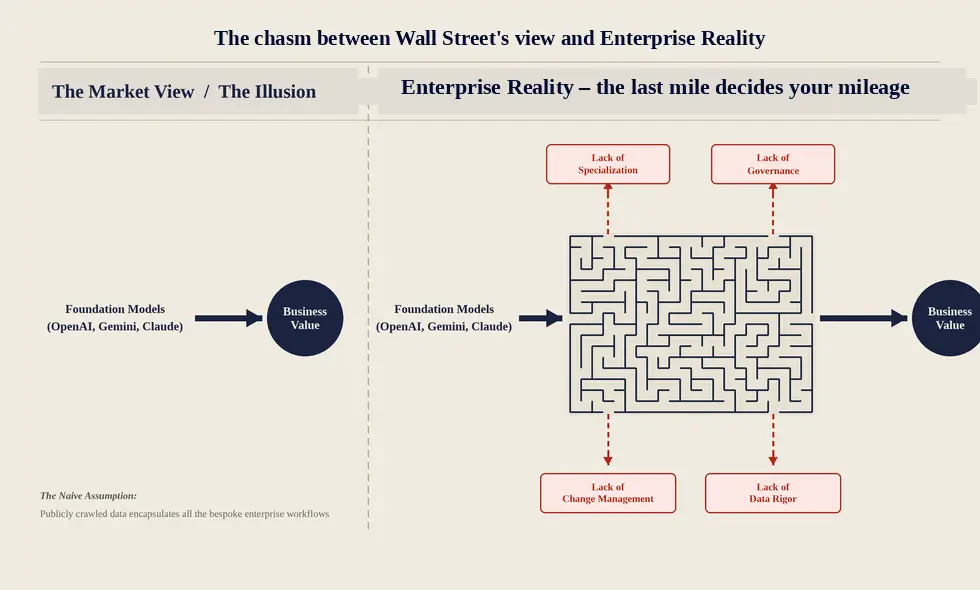
There is a compelling narrative in the market: powerful foundation models will soon run enterprise workflows out of the box, and the path from model to business value will be linear. Access the API, integrate it into existing systems, and the productivity gains will materialize.
Wall Street has largely bought into this theory. Each time a frontier model releases a new capability, enterprise software companies take a valuation hit—on the assumption that AI will commoditize everything they have built. The underlying logic: if the model already knows everything from public sources, why would customers still need specialized middleware, professional services, or industry-specific software platforms?
The thinking is flawed. Top-tier models do draw enormous insight from public data. But they lack the context required to execute enterprise work—the workflows, policies, exceptions, approvals, controls, and accountability that define how organizations actually operate. That missing context creates a chasm between what a model can do in isolation and what enterprises need to realize measurable economic value.
Why Most AI Projects Stall
Study after study, from MIT to McKinsey to leading AI practitioners, converges on the same finding: most enterprise AI projects fail to produce meaningful economic value. The reasons cluster around four fundamental hurdles. They are worth understanding individually, because each one kills projects in its own way.
Lack of data rigor. Foundation models are only as useful as the data they can act on inside your organization. Most enterprises discover, painfully, that their data is fragmented across systems, inconsistent in format, missing key labels, and full of duplication and ambiguity. Without disciplined data engineering—ingestion, integration, cleansing, lineage—every downstream AI initiative inherits that mess. Data rigor is the foundational hurdle; you cannot get started without it.
Lack of specialization. Even with clean data, a generic model is a generic employee. It does not know your firm’s risk appetite, your client classification methodology, your regulatory interpretations, your workflow exceptions, or your internal taxonomy. Closing that gap—the last mile—requires deliberate work to translate general model capability into your specific operating context.
Lack of governance. AI is non-deterministic. It makes errors. In regulated industries, an unsupervised AI decision can become a regulatory event, a customer complaint, or a financial loss. Most enterprises deploy AI without the controls, audit trails, escalation paths, and continuous monitoring that the technology demands. The result is either a system that cannot pass compliance review, or one that does—but no one trusts.
Lack of change management. AI changes how work gets done, who does it, and what skills people need. Most failures here are not technological—they are organizational. Roles are not redesigned. Processes are not rebuilt. People are not retrained. The technology arrives, but the organization is not ready to absorb it.
These four hurdles are where most projects fail. And they are the reason the gap between a powerful model and real business value is not a straight line—it is a labyrinth. The ability to navigate that labyrinth – that last mile – decides an enterprise’s mileage from AI.
Why Last-Mile Specialization Is Business-Critical
Of the four hurdles, last-mile specialization is the one most often misunderstood, so it is worth slowing down on.
Consider how human expertise develops. Students progress from high school to university, acquiring knowledge from public sources—textbooks, lectures, case studies, academic research. By graduation, they have absorbed a broad foundation grounded in publicly available information.
But when they join a firm—say Goldman Sachs or JPMorgan—that education alone does not make them effective. They need training in that firm’s specific ethos: investment philosophy, risk frameworks, client relationships, proprietary research, processes, and culture. That specialized knowledge is what makes Goldman Goldman and JPMorgan JPM. Two MBA graduates from the same program will diverge quickly once one is trained inside Goldman and the other inside JPM.
The same logic applies to AI agents. Today’s foundation models are trained on public data—the web, open-source code, academic papers, public records. They are extraordinarily well-educated in a general sense, but they do not understand your organization.
The chasm between what the model knows from public sources and what it must know to be effective in your environment is bridged by last-mile specialization. Closing it requires sustained, intentional effort, led by people who understand both the AI and the organization.
What Changes Tomorrow and What Does Not
As frontier models grow more capable, the public-knowledge gap will continue to narrow. Future generations of AI agents will absorb more of the public knowledge found in textbooks, research, and open codebases. The “school and university” stage of AI education will get more expansive.
The last mile will not. If anything, it will become a more important differentiator. Goldman Sachs is not going to contribute its proprietary investment insights to OpenAI’s training data—doing so would give away the competitive advantage that defines the firm. Every enterprise, in every industry, has its own version of this logic. The knowledge that makes an organization distinctive is precisely the knowledge it cannot share, and therefore precisely the knowledge that frontier models will not contain.
That has a corollary. Once you customize a model to act on behalf of your firm—especially in a regulated environment—you take on the responsibility for what it does. Governance becomes inseparable from specialization. The future of enterprise AI looks less like “plug in a foundation model and go” and more like this: access the model, adapt it to your proprietary context, integrate it into your workflows, and govern it continuously. That is a significant operational discipline, and most enterprises are not equipped to build it alone.
The New Role of the Systems Integrator
Closing the last mile is not something technology providers can do because they typically lack the deep understanding of the domain and the client. It requires a new kind of organization that combines three capabilities that rarely coexist today: systems design discipline, deep client and domain understanding, and AI expertise. Together, these are what convert a foundation model into a business outcome. This is where systems integrators come in – they have the deep system design discipline, and client and domain understanding, and some (like NTT DATA) are also building the AI expertise to tackle the last mile.
For a deeper look at why this combination is so rare and why this combination matters, read intelligence is a systems problem—and always has been. In my next blog, I’ll explore the topic of intelligence as a systems problem in detail.
Conclusion
The work that will define who actually benefits from AI is everything that has to be built around the model. Cleansing the data. Closing the last mile. Governing the outputs. Redesigning the work.
Closing the last mile is what converts a model into a business. This work will determine who wins in the next phase of AI’s evolution—and whether the hybrid teams of the future remain a vision or become how enterprises actually operate.
About the Author
Bratin Saha is the CEO of NTT DATA AIVista. As a wholly owned subsidiary of NTT DATA, NTT DATA AIVista builds agentic AI capabilities for enterprises in regulated industries like insurance and banking.
Sources
*The GenAI Divide: State of AI in Business 2025, MIT Sloan Management Review
*The State of AI in 2025, McKinsey & Company
