
Top highlights
- The hard part of enterprise AI isn’t the model. It’s translating business context into input a machine can reason over, and historically, that has required scarce, specialized engineers.
- The AIVista Platform generates that ontology from the enterprise’s own documents and scores its confidence field by field. The business expert reviews only what gets flagged.
- In a live insurance back office, that approach raised extraction accuracy to 98.5%, straight-through processing from roughly 70% to 98%, and cut manual review from about 30% of documents to 2%.
Frontier AI models such as ChatGPT and Gemini are impressive, but because they are trained mostly on public data, they are best at generic tasks. A large enterprise, by contrast, runs on proprietary rules, processes, and knowledge that drive its decisions. For instance, determining whether a beneficiary-change request is satisfactory depends on that insurer’s own administrative guidelines, the wording of its forms, and how much variance it tolerates in a signature. The carrier cannot hand decisions like these to a frontier model alone.
In addition, every AI-driven decision must be explainable and auditable, because a regulator, a compliance officer, or an internal auditor will eventually ask why it was made. That distance between a foundation model’s general intelligence and your specific business context is the last mile—and it’s where most of enterprise AI projects fail today. AIVista accelerates the last mile, helping enterprises in regulated industries cross it faster and more efficiently.
Enterprises are moving to a hybrid operating model where AI agents and human workers collaborate — humans bring judgment, empathy, and exception-handling; agents work on structured flows at machine speed. This is the service-as-software paradigm, where software no longer just supports service delivery but performs it alongside people. Because software now performs the service, that service must be accurate, auditable, and grounded in the enterprise’s own data and rules. That is why crossing the last mile has become a business necessity.
The line item nobody budgets for
The last mile has a specific cost, and it’s not GPUs. It’s the cost of modeling a business to create an artifact that a machine can reason over: the entities it deals in, how they relate, the vocabulary each system uses, and the rules that decide what happens next.
That artifact is an ontology. Until recently, there was only one way to build one: a forward-deployed engineer (FDE) sat with the business, learned how the work actually ran, and encoded all of it by hand.
That approach works, but only linearly. It doesn’t scale, because an FDE team needs both deep domain knowledge and the engineering skill to turn it into a running system. Every enterprise is competing for the same small pool of people who have both. Consider one North American life and annuity administration operation:
| The operation | |
|---|---|
| Policyholder requests per year | ~4M transactions |
| Processing personnel | 2,400+ people |
| Distinct business processes | 2,000+ processes |
| Systems touched per request | 5-10 core systems |
At FDE build rates, an enterprise can afford to model only a handful of those several hundred processes. As a result, the pilot succeeds, the business case looks strong… and the program stalls — not because the model was weak, but because the translation layer does not scale with the number of specialists available to build it.
This is why so many enterprise AI initiatives stop at the pilot stage. The constraint is not intelligence. It’s the limited number of people available to do the encoding.
Let the machine draw the map
The first thing the AIVista Platform changes is who builds that map. Instead of an engineer modeling the business by hand, the platform reads the client’s own documents — forms, applications, operating manuals, policy documents — and generates an AI-Ready Knowledge Base from them.
That includes the entities (policy, owner, beneficiary, address-change request), the relationships among them, and the terminology — including the fact that “policy number,” “policy no.,” and “contract ID” refer to the same thing across three different systems.
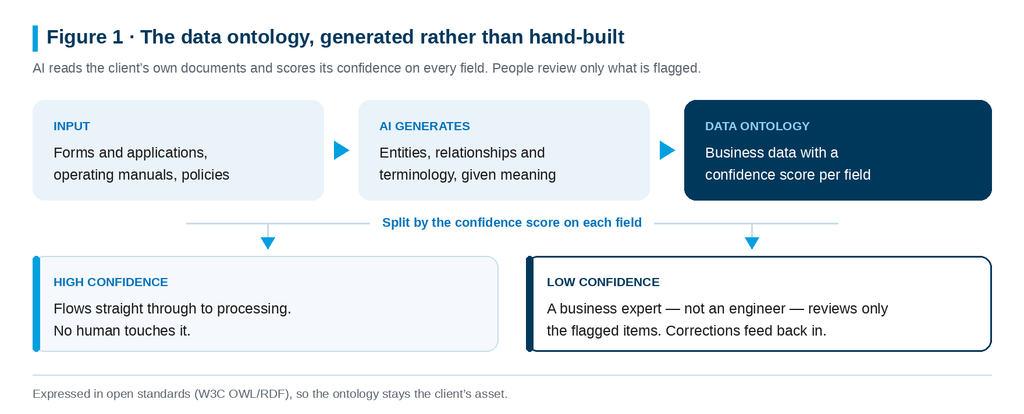
Crucially, every field the platform extracts carries a confidence score. If the system is confident about a field, it flows straight through to processing with no human involvement. If it’s not confident about a field, the system flags it, and a business expert — not an engineer — reviews just those items and corrects them. The correction then feeds back into the system.
This pivot matters commercially. The person who knows that this carrier writes effective dates differently, or that a particular form has a combed signature box, already works in the operation.
The scarce FDE profile is no longer on the critical path, because the work that required it has been converted from building into checking.
Since the ontology is expressed in open standards (W3C OWL/RDF) rather than a proprietary format, it also remains the client’s asset—portable, inspectable, and not tied to a single vendor’s platform.
Your policies and regulations are already the rulebook
A data ontology tells a machine what things are. It does not tell it what the rules require.
That responsibility falls to the second layer. The platform reads the business’s operating manuals, administrative guidelines, and procedures, and extracts the conditions, determinations, and actions a machine can actually check.
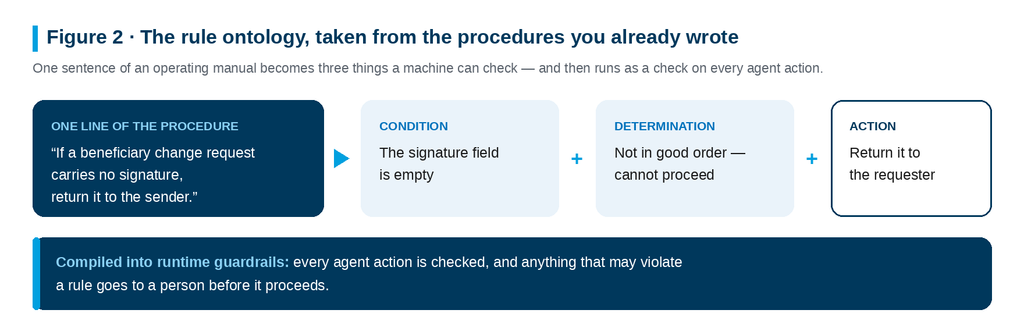
This layer is necessary because the same nominal process is governed by different rules at different companies — and those differences are invisible to a general-purpose model.
When an incomplete or unclear request arrives, one carrier simply rejects the form. Another checks whether the signature is proper, confirms the address belongs to a real client, and sends the request on for further processing. A frontier model cannot reproduce that distinction, because the distinction is not in the public record — it’s in that company’s guidelines.
Each client’s rules must be machine-readable, and encoding them by hand would bring back the bottleneck we just removed.
Once compiled into Specialized Guardrails, those rules run as checks on every agent action, with a trace back to the source document behind each decision. Reasoning is neural; checking is symbolic. The agent proposes, the guardrails verify, and anything that could violate a rule gets routed to a person before it proceeds.
What it looked like in a back office
In one insurer’s back office, the most stubborn problem was also the most mundane: reading handwriting. Digits and letters that look alike — 0 and O, 1 and I, 5 and S — prevent accurate single-shot extraction, which plateaus at 50–72% accuracy on real handwritten fields. 5-3 forms in 10 were being read by a person.
With specialized models applied against the two ontologies, extraction reached 98.5% accuracy on a couple of hundred production documents across several trials (compared to 50–72% for general-purpose models performing the same task).
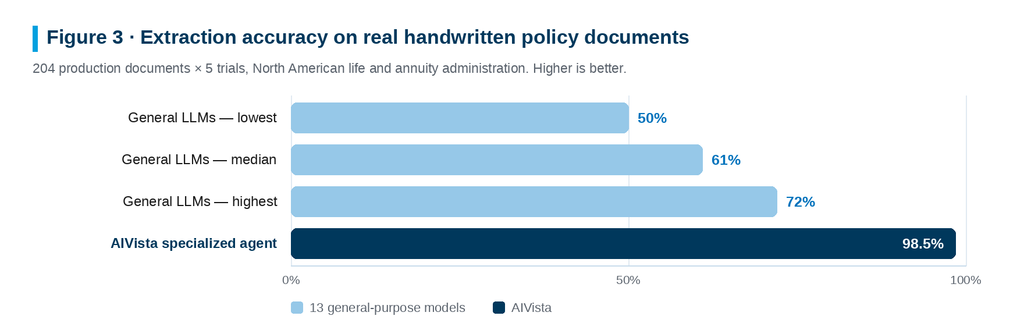
The accuracy number is the headline, but the operational consequence is the part worth putting in front of a board.
Straight-through processing rose from 70% to 98%, and the share of documents routed to a person for review fell from roughly 30% to less than 2% — 15 times fewer. Reviewers now focus on what the system could not settle on its own.
Whoever builds the ontology decides everything downstream
| The conventional approach | AIVista | |
|---|---|---|
| How the ontology is built | Hand-built on site by forward-deployed engineers | Generated automatically from the client’s own data |
| Who is involved | Rare, highly skilled specialists staffed across the whole build | Business experts review only what is flagged as “low-confidence” |
| Standards | Proprietary to the platform | Open standards (W3C OWL/RDF) — no lock-in |
| Rules | Data-centric; no dedicated mechanism for rules | A rule ontology as well, with proof traces |
| Enforcement | People are expected to follow the operating rules | Guardrails check every action by machine |
| Auditability | No traceability back to the rule documents | Every decision traceable to its source evidence |
Three takeaways
The challenge of enterprise AI is not simply building better models. It is translating business knowledge, processes, and rules into a form that AI can reliably understand and act upon. AIVista addresses this challenge by changing how enterprises build and scale AI automation.
For executives considering enterprise-wide AI adoption, three points matter:
- You don’t need to depend on scarce FDE talent. By automating ontology generation, AIVista enables business experts to validate AI-generated knowledge rather than relying on engineers to build everything from scratch.
- Scaling automation no longer requires scaling engineering effort at the same rate. Because new processes no longer have to be modeled by hand, AIVista significantly reduces the cost and effort of adding new business processes, making enterprise-wide automation economically viable rather than limiting success to a handful of pilots.
- Explainability and governance are built in from the start. By combining data and rule ontologies with specialized guardrails, AIVista enables AI-driven decisions to be validated against business rules and traced back to their source documents.
None of this eliminates the need for engineering. Deploying the platform, integrating enterprise systems, and operating AI solutions remain essential responsibilities — and areas where engineers play a critical role.
The real breakthrough is making enterprise AI scalable without making specialized engineering talent the bottleneck.
